Why Post-Acute Care’s Next Competitive Advantage Is Clinical Ecosystem Management
As risk-based reimbursement expands, post-acute care (“PAC”) operators will be judged less by isolated episodes of care and more by how effectively they coordinate hospitals, payers, physicians, home-based providers, and families around the patient transition.
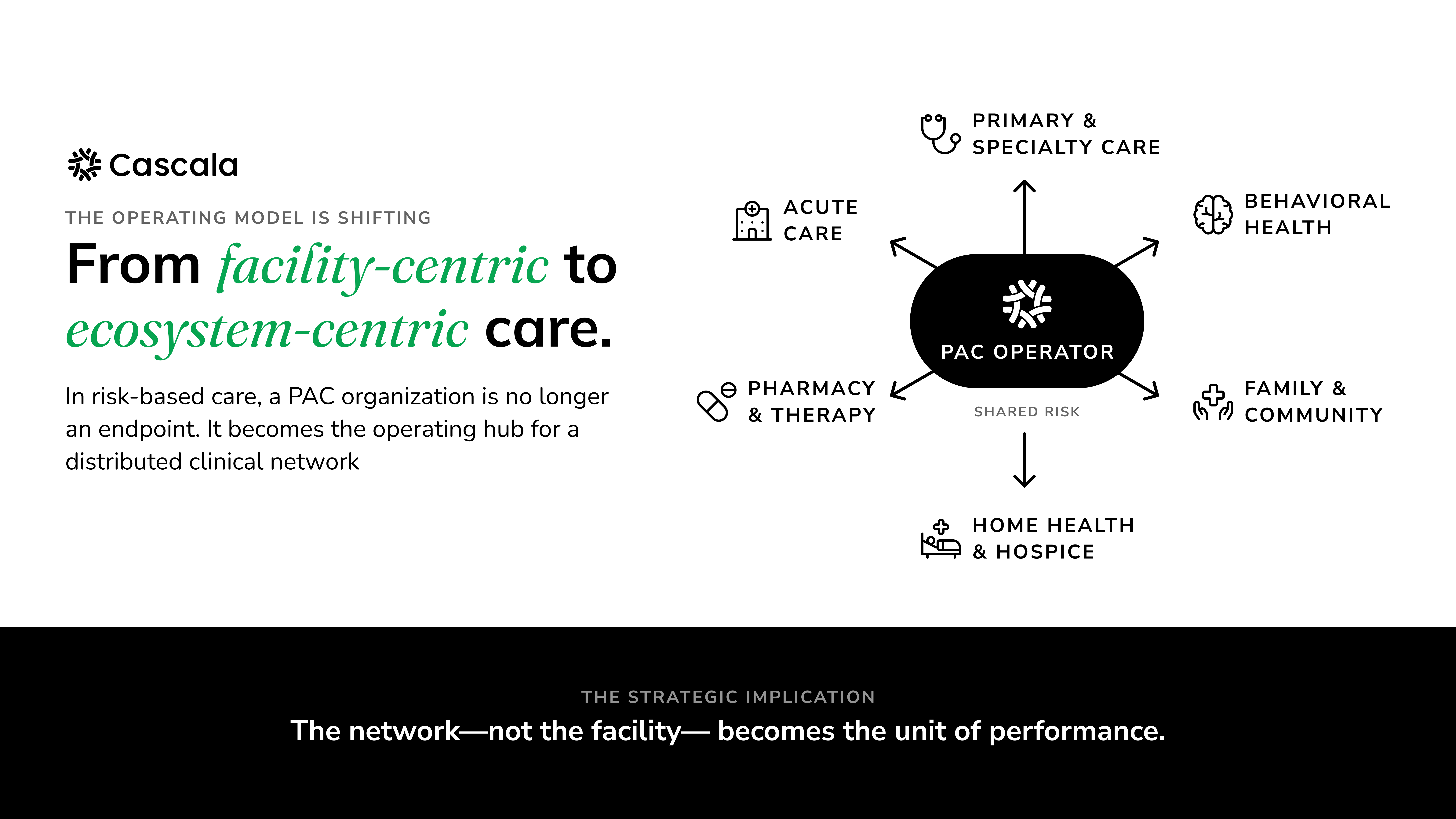
For years, post-acute care operators were evaluated primarily as destinations in the care continuum. Could they accept the referral, manage the patient safely, and keep operations running in a difficult reimbursement environment? That view is becoming outdated. In risk-based reimbursement, post-acute providers are no longer just destinations. They are increasingly expected to function as active coordinators inside a broader clinical ecosystem that includes hospitals, ACOs, Medicare Advantage plans, primary care, specialists, home-based providers, caregivers, and community organizations. That change is not theoretical. It is being written into payment models, quality programs, and discharge requirements across Medicare.
The timing matters. More than half of Medicare beneficiaries are now enrolled in Medicare Advantage, 1 and CMS has reported that more than half of people in Traditional Medicare are already in an accountable care relationship.2 Meanwhile, the TEAM model makes hospitals financially accountable for episode costs that extend 30 days after discharge and explicitly include post-acute services such as SNF stays and follow-up care. 3 The message is straightforward: the economics of Medicare increasingly reward organizations that can manage transitions well, avoid preventable utilization, and move information quickly across settings.
From facility-centric to ecosystem-centric
That creates a new reality for PAC operators. In a fee-for-service mindset, the strategic question was often, “How do we win more referrals?” In a risk-based mindset, the more important question becomes, “How do we become an indispensable operating partner to the organizations that are accountable for outcomes and cost?” Those are different games. The first is about access. The second is about trust, responsiveness, data, and reproducible coordination.
The challenge is that the industry’s care transitions infrastructure is still far weaker than the reimbursement environment now assumes. In a national survey of hospital-SNF information sharing, only a small minority of hospital-SNF partners reported excellent performance on completeness, timeliness, and usability. Key information often arrived late—frequently after the patient—and important details, such as behavioral status and social status, were commonly missing. 4 CMS has separately highlighted recurring discharge omissions involving diagnoses, medications, behavioral-health needs, durable medical equipment, advance directives, and home-environment considerations. 5 In other words, the system is demanding coordinated care before the underlying operating model is consistently coordinated.
Ecosystem management becomes the differentiator
That is why ecosystem management is emerging as a differentiator. The best post-acute operators are not simply improving what happens inside the episode; they are reducing friction around the episode. They are easier for hospitals to discharge to, easier for ACOs to work with, easier for physicians to align around, and easier for families to navigate. They can standardize handoffs, close communication loops, surface clinical changes quickly, and maintain continuity as patients move from acute care to facility-based care to home and community settings.
In practical terms, that operating model requires five capabilities:
- Closed-loop communication: Critical updates should be routed to the right clinical partner, tracked to resolution, and visible across the transition—not left in inboxes, faxes, or disconnected portals.
- Longitudinal visibility: Operators need to see the patient’s trajectory before admission, during the post-acute episode, and after discharge so risks are managed as a continuum rather than as isolated events.
- Partner-specific workflows: Primary care, specialists, behavioral health, pharmacy, home health, hospice, and family caregivers each require different information, timing, and follow-through.
- Proactive risk identification: The operating model must surface clinical and operational risks early enough to change the outcome, not simply document them after the fact.
- Shared performance accountability: PAC operators increasingly need to demonstrate performance on readmissions, infection-related hospitalizations, transfer quality, responsiveness, staffing stability, and post-discharge follow-through.6
What sophisticated partners will expect
The organizations that stand out in this environment will likely share three characteristics. First, they will treat partner management as a clinical capability, not a sales function. Second, they will speak in the language of their risk-bearing counterparts by showing performance on outcomes, responsiveness, transfer quality, and post-discharge execution. Third, they will build workflows that extend beyond admission and discharge and into the full transition arc, including medication reconciliation, primary-care follow-up, home-based services, escalation pathways, and caregiver engagement.
This is increasingly what sophisticated ACO-SNF and hospital-PAC partnerships require: data sharing, admission and discharge notifications, agreed-upon care pathways, and performance against shared goals rather than loose referral relationships.7 Preferred-network status will be earned less by a static quality score and more by the ability to execute reliably as part of a broader care model.
What clinical ecosystem management looks like
Clinical ecosystem management connects the information, people, and workflows involved in a care transition. For post-acute organizations, that means receiving a more complete clinical picture, understanding risks and follow-up needs earlier, and giving each team access to the same source-cited context as the patient moves across settings.
Related: Post-acute care solutions for SNFs, home health, and hospice · Explore the Cascala platform
What this means for Post-Acute leaders
This has strategic implications for every PAC operator, whether facility-based or home-based. If nearly half of Medicare patients leaving hospitals enter some form of post-acute care, then PAC is one of the most important control points in the continuum.8 Operators that can manage this moment as a networked process rather than a point-in-time handoff will be better positioned in Medicare Advantage contracting, ACO relationships, bundled-payment alignment, and hospital partnership strategy. Operators that cannot will increasingly look interchangeable, even if the care they provide inside their own walls is strong.
The industry has spent years talking about care transitions. The shift now is more consequential: transitions are becoming measurable, contractual, and financially material. Post-acute leaders should respond accordingly. The next wave of competitive advantage is unlikely to come from bed count alone, geography alone, or even service-line breadth alone. It will come from the ability to function as a high-trust orchestration layer across the clinical ecosystem surrounding each patient.
In a risk-based world, that may be what separates providers that receive referrals from providers that become true strategic partners.
What the market now needs most is infrastructure that can coordinate clinical partners, communication, and accountability across the transition arc — Cascala can help.
Referenced:
- 1) KFF: Medicare Advantage enrollment update and key trends, 2026
- 2) CMS: Accountable care progress and 2025 ACO initiatives
- 3) CMS: Transforming Episode Accountability Model (TEAM)
- 4) JAMA Network Open: Hospital-SNF information sharing practices
- 5) PACIO: Post-acute interoperability and fragmented transitions
- 6) CMS: SNF Value-Based Purchasing FY 2026 fact sheet
- 7) AJMC: Characteristics of ACO preferred SNF networks
- 8) MedPAC: Report to the Congress, March 2026 — Post-acute care: Trends and key issues